
3D Printing

Introduction

Have you had trouble in the past with traditional manufacturing methods for quickly producing unique shapes or large numbers of different parts? Traditional fabrication techniques produce large amounts of scrap material, require longer setup times, and offer less flexibility when changing your product design. As the world moves toward faster engineering design times and more custom products, many companies are looking to adopt new technologies that can produce parts much faster and offer designers greater flexibility when designing their products.
3D printing provides a modern way to manufacture products by adding layers of materials directly from digital CAD models. The 3D printing process eliminates the need to build prototypes using expensive molds and tools, allowing engineers to easily create lighter-weight structures and complex geometries. Due to its benefits, additive manufacturing is becoming an increasingly viable alternative across industries such as medical devices, aerospace, automotive, and electronics.
Concept of 3D Printing

The core idea behind three-dimensional printing, or additive manufacturing, is to convert a 3-D CAD Model into a 3-D Physical Object by depositing layers at a time. The CAD Model is first converted into an STL file or other mesh formats for processing by the slicing program. The Slicing Software breaks down the object's geometry into very thin slices or layers and creates a machine-readable file called G-code. G-code contains information regarding the path that the print head will follow (Tool Path), how fast it will move (Extrusion Rate), how much energy will be applied (Laser Power), and how tall each layer will be.
In addition to creating G-code, during production, material is added to the build platform, layer by layer, from left to right and front to back, to create the 3D Object. The ability to add layers one on top of another allows engineers to create objects with specific characteristics, such as Lattice Structures, Infill Density, and Complex Geometries that would be extremely difficult, if not impossible, to produce using Subtractive Manufacturing. Additive Manufacturing enables Engineers to rapidly prototype parts, optimize part topology, and manufacture custom components with minimal material waste and little to no reliance on specialized tooling.
Working Principle of 3D Printing

The basic concept behind how a 3D printer works begins when you create a 3D computer-aided design (CAD) file, and export it in STL (Stereolithography), OBJ (Object File Format) format for further use by your slicing software. That CAD file, once sliced and converted into layered tool paths, is then exported into G-code, which contains all the data that tells your 3D printer exactly how to create each and every layer of a part, i.e., layer height, print speed, temperature, etc., as well as the type of fill or infill you want within each layer.
nce the 3D printer receives those G-code instructions and begins to make the part, it uses them to extrude, cure (using UV light), or fuse (using a laser or electron beam) material, one layer at a time, moving back-and-forth in the X, Y, and Z axes until it has created the entire 3D object. Depending on the specific 3D printing method being used, there are several ways the material can be deposited onto the build platform including; melted and squeezed out of a hot nozzle (as in Fused Deposition Modeling (FDM)), selectively cured using UV light (in Stereolithography (SLA)/Digital Light Processing (DLP)), or fused together using a high-powered laser or electron beam (as in Selective Laser Sintering (SLS) and Direct Metal Laser Sintering (DMLS)). Each new layer is bonded to the previous layer through thermally induced bonding, chemical bonding, or photopolymerization, and ultimately forms the final 3D product. To ensure that each layer adheres to the layer below it, and that the overall dimensions of the part remain accurate, and that the finished product will have the structural integrity needed to perform its intended function, precise motion control systems, temperature control systems, and real-time calibration methods are employed during the build process.
Classification of 3D Printing Technologies

The primary difference among 3D printing methods lies in the mechanisms used to deposit, solidify, or melt the materials in the additive manufacturing process. Therefore, each additive manufacturing method offers unique advantages to users in terms of resolution, material compatibility, mechanical strength, and the rate at which parts can be produced.
Fused Deposition Modeling (FDM)
FDM is one of the most common additive manufacturing methods and has been used for many years. FDM uses melted plastic filament to create layers of the product, which will eventually form when all the layers are added together. The 3D printer that creates the layers of the product follows specific paths that were created by a computer program called slicing software that also controls factors such as how much of the object is filled with a solid material (infill), how tall the layers of the product are, and the speed at which the layers are created.
Stereolithography (SLA)
SLA is another very popular additive manufacturing technique. The method uses an ultraviolet laser to solidify a liquid photopolymer resin, creating solid layers. The layers of the product that are created by SLA have extremely high dimensional accuracy and are very smooth. These characteristics make SLA ideal for developing prototypes with very fine details and/or complex shapes. However, after the SLA layers are printed, they usually need to be cleaned and post-cured to achieve the desired mechanical properties.
Digital Light Processing (DLP)

DLP is similar to SLA except that instead of using a laser to solidify each layer of the product individually, a digital projector cures an entire layer of resin at once. While the curing time per layer is shorter using DLP, the overall time required to complete a project may actually be longer if the number of layers is large. However, since the projector can cure an entire resin layer simultaneously, the overall time to complete a project may still be faster than with SLA.
Selective Laser Sintering (SLS)
SLS is a high-power laser additive manufacturing technique that fuses powdered materials, such as nylon and polymer composites, to form solid structures. Because the surrounding powder acts as a support for the product during the sintering process, there is no need for additional support structures for complex geometry products. The high temperature produced by the laser melts and bonds the surrounding powder, forming the product's solid structure.
Direct Metal Laser Sintering (DMLS)
DMLS is a metal additive manufacturing process that uses a high-powered laser to sinter fine metal powders into solid structures. DMLS enables the creation of a wide variety of metallic parts with complex internal features that are difficult to manufacture using conventional machining techniques. Because of the high density and mechanical strength of parts produced using DMLS, this technology is widely adopted in industries such as aerospace, automotive, and medical devices for the production of lightweight, high-performance components.
Material Jetting
Material Jetting is an Additive Manufacturing Process where a 3D printer deposits small amounts of liquid Photopolymer onto the Build Platform and cures it instantly with UV Light. This enables the user to produce parts with multiple materials and surface details at a level of detail far beyond what can be produced using other Additive Manufacturing Techniques.
Materials Used in 3D Printing

A wide variety of materials can be printed in three-dimensional form using FDM printing; these materials were selected based on criteria such as mechanical performance, thermal resistance, flexibility, and intended use. The specific material selected will determine the quality of the printed product, its durability, and its functional characteristics.
Thermoplastics (PLA, ABS, PETG):
Thermoplastic materials are the most commonly processed into products by FDM printers due to their ease of use and relative cost. Thermoplastics have good printability and minimal warping. They also exhibit relatively lower strength and less thermal resistance than some other materials. Some thermoplastics also exhibit improved strength and thermal resistance over others. Thermoplastics also offer a balance of flexibility, durability, and chemical resistance, making them well-suited for functional prototype parts.
Photopolymer Resin:
Photopolymer resin is used in SLA and DLP printing to create highly detailed models and prototypes. Photopolymer resin cures upon exposure to ultraviolet light. The cured resin exhibits very-high-resolution and very-smooth surface finish characteristics. Various resin formulations exist, which include flexible, strong, and high-temperature versions.
Nylon and Powdered Polymers:
Nylon-based powdered polymers are used extensively in SLS printing due to their high strength, flexibility, and abrasion resistance. Nylon-based powdered polymers enable the printing of complex geometries without support structures. The resulting printed objects are typically used for functional prototypes and lightweight mechanical components.
Ceramic and Advanced Materials:
High-end 3D printing machines can process ceramic powders and other advanced materials for high-temperature or biomedical applications. Ceramic materials and other advanced materials exhibit excellent thermal stability and chemical resistance. However, ceramic and other advanced materials often require additional post-processing steps to achieve maximum strength and durability.
Components of a 3D Printer

A 3D Printer System typically has multiple key components that work together to accurately deliver Material to the Build Platform, control the Motion of the 3D Printer System, and regulate temperature during the Fabrication Process.
Print Bed (Build Platform)
The Print Bed is the location on the 3D printer where the part is created one layer at a time. In many cases, the Print Bed will have heating elements to promote Adhesion between the part being printed and the Print Bed, and to prevent Warping of the part during the fabrication process. Proper Bed Leveling is critical in order to maintain Proportional Dimensions between Layers.
Extruder or Energy Source
In a 3D printer system, the extruder is the mechanism that delivers filament to the Nozzle and Melted prior to Material Deposition. The Energy Source is responsible for providing Power to solidify the Material deposited in laser-based systems and Resin Systems using UV Light. The Energy Source controls the Flow of Material and Formation of Layers.
Motion Control System
Precision Movement along the X, Y, and Z Axes is controlled by Stepper Motors, Belts, and Linear Rails. The Motion Control System follows Tool Paths developed by Slicing Software to position the Print Head precisely. High Precision from the Motion Control System produces Smooth Surfaces and Consistent Geometry.
Design Considerations for 3D Printing

Designing products using additive manufacturing (such as 3D printing) differs from traditional manufacturing design. When designing a product using additive manufacturing, engineers will need to evaluate many factors, including layer orientation, structural integrity, and overall print efficiency, to produce a reliable, acceptable-quality product.
Select the best way to orient your layers in order to increase the strength of the part and decrease the amount of support that is needed.
Ensure that you have sufficient wall thickness to keep the printed parts structurally stable during printing.
When designing, try to keep the overhang angle as small as possible to minimize the support structure required.
When designing, take into account material tolerances and shrinkage to ensure the final product maintains its correct dimensions.
Optimize the infill density and pattern to meet your needs for weight, strength, and print time.
Try to avoid sharp internal corners when designing your parts, as they can create high stress concentrations that can lead to warping.
When designing your parts, consider the thermal properties of the materials you use so they do not deform as they cool.
Applications of 3D Printing

The ability of 3D printing to produce custom designs, complex geometries, and rapid prototypes with minimal waste is why it has become a key factor in many industrial sectors.
Rapid Prototyping:
Engineers can quickly create test designs using 3D printing to determine whether they will work before mass-producing them. Because of this faster development process, the engineers can make design changes more quickly than they could without 3D printing. Rapid prototyping is typically found in product development or research environments.
Medical and Healthcare:
Customized prosthetics, dental models, and surgical guides can be produced using additive manufacturing to meet each patient's needs. Additive manufacturing also enables the production of lightweight biomedical components that provide the exact amount of support the patient needs. Anatomical modeling of the body for medical education and training is also supported by the technology.
Automotive/Aerospace:
Structural parts for aerospace vehicles, as well as aerodynamic components and tooling fixtures for automotive manufacturers, are printed. Internal geometry is complex, and therefore, the structure of the part is reduced, but the strength of the part remains the same. Improved fuel efficiency and performance are achieved through reduced weight.
Consumer Electronics/Products:
Enclosures, mounts, and experimental electronic structures are created using 3D printing. Customization and low-volume production can be done at a lower cost without expensive tooling. Startups often use 3D printing to expedite product development.
Advantages of 3D Printing

Traditional manufacturing techniques offer advantages over three-dimensional (3D) printing technology in many ways. However, the benefits of 3D printing lie in its flexibility, efficiency, and ability to promote new ideas in product development.
Flexibility in Design:
The complexity of designs and their geometry can be achieved through 3D printing without additional tooling. For example, engineers can now produce products with internal channels and lightweight lattice structures, which have been challenging to achieve using traditional manufacturing techniques.
Prototyping Rapidly:
The additive manufacturing process, or 3D printing, allows designers to rapidly convert digital models into physical prototypes. Through this rapid prototyping process, designers can test and iterate more quickly and efficiently. Additionally, the rapid prototyping process reduces the time needed to develop a product, enabling designers to identify potential design flaws early.
Customization and Small-Batch Production:
One of the biggest benefits of 3D printing is the ability to create custom designs without the expense and time required to set up molds. In addition, 3D printing is well-suited to small-batch production and the creation of one-off components.
Lower Costs for Early Stage Production:
By eliminating tooling and reducing machine setup time, 3D printing lowers costs for early-stage production. Engineers can quickly and inexpensively test multiple versions of a design before committing to a final version.
Limitations and Challenges

LIMITATIONS
Production speed is slower than most other traditional forms of mass production.
Thermal distortion or shrinking during cooling can affect the dimensional accuracy of parts.
Parts made through layer deposition exhibit anisotropic (directionally dependent) mechanical properties.
There are physical limits on how large a part can be printed due to the printer's build envelope.
CHALLENGES
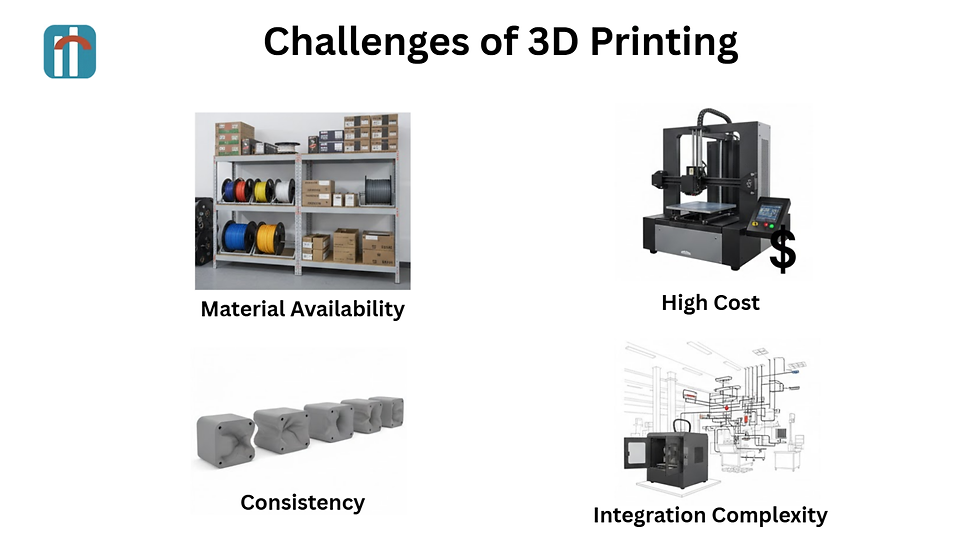
The availability of many of the newer, high-performance, and industrial-grade materials remains very limited at this time.
Industrial 3D printers, especially those designed for production use, have extremely high entry costs.
Printers tend to lose consistency in producing good prints over long periods of continuous operation.
Integrating 3D printing into a company's current production environment can be difficult.
Future Trends in 3D Printing
Additive manufacturing has evolved dramatically over the past few years with advances in multi-material printing, metal additive manufacturing, and artificial intelligence-based design optimization. Future directions for this technology include improved print speed, more durable materials, and the integration of electronic and functional elements directly into the final product during the additive manufacturing process. The development of automation and smart manufacturing technologies will also benefit the development of larger-scale, on-demand, and distributed manufacturing platforms across multiple industries.
Conclusion
Modern Manufacturing has been significantly impacted by 3D Printing, which offers a wide range of possibilities for Rapid Prototyping, Design Flexibility, and Reduced Material Usage. Although there will continue to be restrictions on Speed, Materials, and Cost associated with 3D Printing, ongoing technological advancements will enable 3D Printing to expand its capabilities and potential applications. The adoption of advanced Additive Manufacturing Solutions by Industries will further solidify the role of 3D Printing in future Engineering and Production Workflows.
Next Read:
EMI Shielding in PCB Design


Comments