
Waterproof PCB: Everything You Need to Know


1. Introduction: Electronics in Harsh Environments
Waterproof PCB designs must withstand harsh environments and operate efficiently in any electronic device. Temperature and humidity can degrade the instrument or the sensors used in the electronics. So, waterproofing is needed to protect them using a different type of protective coating. Water can seep through the seams, cable entries, or enclosure joints on PCBs. Therefore, waterproofing is important in PCB design for various applications. This article provides an overview of waterproofing, its design considerations, testing standards, and applications.
2. What Makes a PCB “Waterproof”?

A bare PCB used in electronics is generally not waterproof. Waterproofing protects it in harsh environments. A PCB is considered waterproof when it remains functional after being exposed to water. There are several elements that make a PCB waterproof, as given below:
Physical barriers that keep water away from the conduction paths.
Chemicals or coatings that resist moisture absorption, corrosion, and ionic degradation.
Sealing cables and connectors from the outside to resist cyclic loads, temperature changes, etc.
The design that controls the water flow within the PCB enclosure.
3. Waterproof vs Water-Resistant PCBs

There is a vast difference between water-resistant and waterproof PCBs. A waterproof design means the PCB endures harsh water exposure, as validated by standards such as IPx7 or IPx8. But water-resistant means the design only tolerates humidity, rain, and splashes. The PCB cannot function without waterproofing when submerged in water or exposed to harsh environments. The table above shows the difference between waterproof and water-resistant PCBs.
4. Key Protection Techniques

Several methods protect PCBs against water and other harsh environments. Some of these are given below:
Conformal coating
A conformal coating is a thin polymer coating applied to the surface of PCBs. We use acrylic, silicone, polyurethane, and epoxy-type materials to coat PCBs. We use spraying, dipping, brushing, and robotic coating methods to coat the PCBs according to requirements.
The benefits of applying conformal coating are
It protects against moisture, light contamination, and condensation.
It adds minimal thickness to the PCB.
It can enable inspection and rework of the PCB.
Drawbacks of Conformal coating are
This coating covers the gaps around the sharp edges or at the connectors that can become the failure point for the PCB
It requires very clean and dry boards before applying it to the PCB
Potting
Potting is the process of filling the enclosure or cavity with resin, turning a PCB into a Solid block. Epoxy, polyurethane, or silicone is used as a potting material for waterproofing PCBs.
The benefits of applying potting are
It gives the highest level of mechanical and moisture protection.
It has excellent impact and vibration resistance.
It is suitable for deep immersion and harsh environments.
Drawbacks of potting:
This process adds weight and traps heat, which can lead to overheating.
Maintaining the system is extremely difficult or impossible after potting.
Epoxy and similar materials, as well as the potting process, are more expensive than other processes.
Encapsulation
Encapsulation is similar to potting, but it can focus on the full PCB or key areas. In full encapsulation, the entire PCB is encapsulated in molded or cast materials. However, selective encapsulation seals only major areas, such as the power section, RF ends, and connectors, to protect against moisture and temperature.
The benefits of encapsulation are
It balances protection and rework on the PCB by encapsulating the sensitive areas.
It reduces material and PCB weight compared to full potting.
However, it requires complete flow-path designs to encapsulate the PCB. Sometimes it is combined with conformal coating for rework, which makes it cheaper.
Nano coating/ Hydrophobic coatings
Nano coating is the process of applying extremely thin layers to a PCB surface. This type of coating has minimal impact on the PCB's weight and dimensions. This process is well-suited for tiny mobile boards and wearable components, where minimizing weight matters. Nano coating is generally used as a complementary process; it is not a replacement for other types of coatings, such as conformal or potting.
5. Material Selection for Moisture Resistance

Material selection is a crucial step in a waterproof PCB. There are some common materials that are used to resist moisture and water, as given below:
Substrate: Low-absorption laminates or high-reliability materials, such as Standard FR-4, are used.
Solder masks: Low-porosity solder masks with strong adhesion reduce water and ionic contamination in the PCB system.
Metallization and finishes: The corrosion-resistant finishes, such as Electroless nickel immersion gold or other high-reliability plating, can be selected to extend the system's lifespan compared to bare copper.
Sealants and gaskets: Sealant and gasket materials must withstand UV exposure, cyclic temperature extremes, chemical exposure, and compression over the PCB's lifetime.
6. Design Considerations of Waterproof PCB
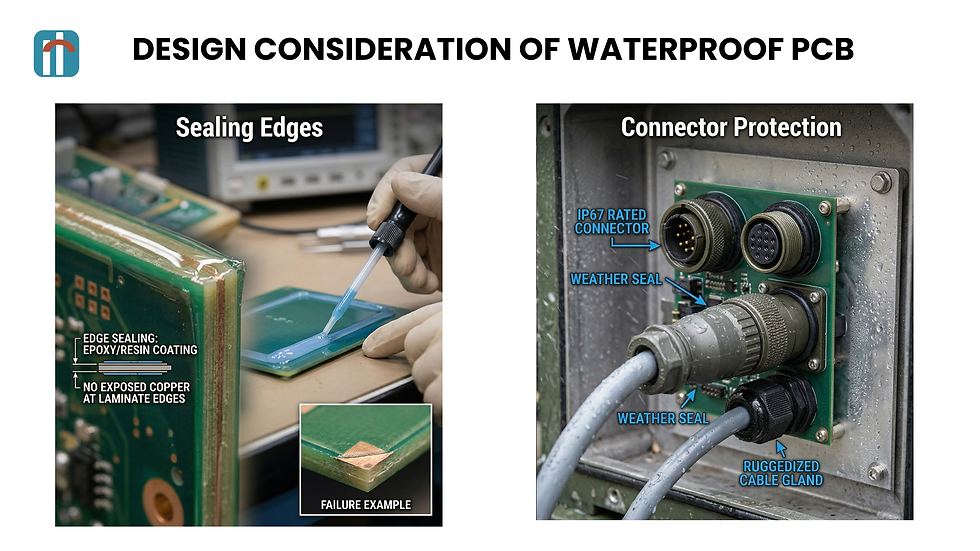
The waterproof PCB needs to consider the following things for proper waterproofing:
Sealing Edges
The PCB board can act like capillaries, drawing moisture into the laminated section. Therefore, protect the copper edges. Apply materials such as epoxy or resin to coat PCB edges for very wet, submerged applications. Avoid uncontrolled via-in pads or open areas, as they expose edges.
Connector Protection
Connectors and cables are the most common leak paths in the PCB system. Select IP-rated connectors and cables for PCBs that are submerged or placed in harsh environments. Seal components like switches and membrane keypads in the assembly, and use a wireless interface instead of a physical one in extreme environments.
7. Testing Standards (IP Ratings)

The ingress protection (IP) rating is a widely recognized standard for testing water resistance in PCBs. In the IPXY format, X denotes dust protection, ranging from 0 to 6. Y stands for water protection, ranging from 0 to 9 K. The following are the relevant water protection levels, which are given below:
IPx4-it resists splashes of water from any direction.
IPx5/x6- resists water jets at defined pressure and distance.
IPx7- It protects the system up to 1 m immersion for a specified time.
IPx8: It tests the system when immersed beyond 1 m under conditions agreed with the manufacturer.
A waterproof PCB assembly is tested against these standards, and certification is provided based on the PCB's or each component's test results.
8. Applications of Waterproof PCB

Waterproof PCBs are used in several consumer electronics, as well as in medical and sports devices, to control systems. The most common applications of the waterproof PCB are given below:
Wearable and consumer electronics, such as smartphones, earbuds, and cameras.
Outdoor and industrial controls such as streetlights, field sensors, and smart meters.
Automotive and marine electronics, such as engine control units and board electronics, are exposed to or immersed in water.
Home appliances such as washing machines and kitchen appliances.
Medical and sports devices, such as disinfection equipment.
9. Common Failures & Prevention

The most common problems that occur in the waterproof design of PCBs are given below:
Water can leak through gaskets, gaps, and poorly sealed fastener threads.
Moist air can become trapped in the enclosure and condense on cold surfaces when temperature varies widely.
Coating peeling and adhesive cracking from water absorption over time can cause system failure.
The ionic residues on the surface can create conductive paths that lead to corrosion growth.
To avoid the failure of the waterproofing, there are some common prevention strategies that can mitigate failure in waterproof PCBs:
The proper design, with cyclic testing under pressure and temperature, can reduce the risk of system failure.
Cleaning the PCB boards before applying the protection coating minimizes ionic contamination.
Use of the desiccant in sealed enclosures also reduces the condensation problem
10. Conclusions
Waterproof PCB design is a systematic process for protecting a PCB from water and harsh environments. Proper PCB design and the right selection of coatings, such as conformal coating, potting, or encapsulation, make it more robust and waterproof. Design considerations during PCB fabrication also help reduce failures and extend PCB lifespan. Waterproof PCBs have several applications, including consumer electronics, marine applications, and industry.
11. FAQs
1. Why do I need a waterproof PCB?
A waterproof PCB can be used in harsh environments. The coating resists water and moisture, and the PCB operates reliably when immersed, keeping the electronic system functioning. Without waterproofing, the PCB can't operate underwater, which can cause overall system failure.
2. How does the IP rating relate to PCB?
The IP rating verifies the PCB system's protection level. In PCBs, the IP rating refers to the reliability of components that have passed the standard tests, after which we can use that PCB in our system.
3. What is water resistance, and what is a waterproof PCB?
Water resistance protects only against moisture and splashes. A waterproof PCB, by contrast, can be immersed in water and withstand harsh environments.


Comments