
RS-274X (Extended Gerber)

Updated: Aug 27, 2025

Abstract
RS-274X (Extended Gerber) has become a game-changer for engineers and manufacturers in the world of printed circuit boards. This format builds on the older RS-274-D Gerber format by adding essential details, such as layer setups, aperture information, and fabrication notes, in a single ASCII file. Unlike its predecessor, RS-274X streamlines the process by keeping everything organized and reducing mix-ups during production. This article shows how this PCB has become the backbone of modern PCB workflows, bridging the gap between design and function.
What is RS-274X Extended Gerber?
RS-274X Extended Gerber is a 2D vector data file format for transferring PCB layout data. Gerber Systems introduced it in 1998 as an extension to the fundamental RS-274 format, with additional features including support for outline layers, enhanced image capabilities, and support for netlists. The format plays a key role in fabricating and assembling PCBs with a simpler structure than its competitors, such as ODB++ and IPC-2581. It has all the data required to create a PCB and is an industry standard that is accepted far and wide, as it is easily backward compatible.
Key Features of RS-274X
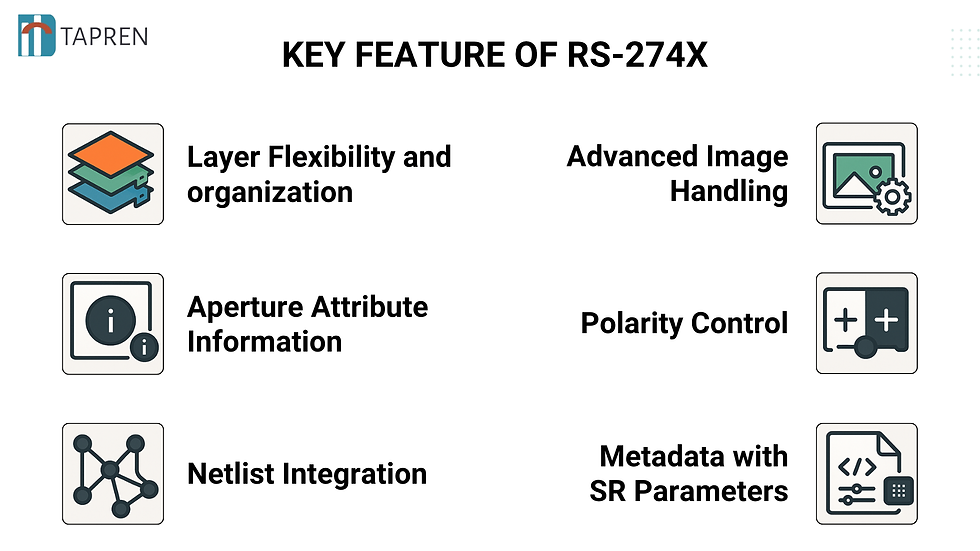
The diagram above illustrates the primary features of RS-274X Extended Gerber, making it a highly successful tool in PCB manufacturing. Some of the features are elaborated on in detail below;
1. Layer Flexibility and Organization
RS-274X contains different layers of images (copper, silkscreen, solder mask, drill, and profile), enabling the designer to separate PCB layout data into different files. This allows the selective editing of specific parts without affecting the rest of the design, thereby easing manufacturing through selective layer treatment.
2. Aperture Attribute Information
RS-274X includes mandatory metadata with apertures (circles, rectangles, polygons) specifying hole diameters, pad shapes, and line widths. Such precise definitions enable manufacturers to select the optimal tools and settings, thereby reducing fabrication errors and ensuring that the resulting PCB meets design specifications.
3. Netlist Integration
The geometry supports netlist data in the form of electrical connectivity, pads, test points, and component characteristics, which are mapped. The assembly integration offers increased assembly efficiency with precise automated equipment commands and electrical integrity verification on the shop floor.
4. Advanced Image Handling
RS-274X supports advanced pattern repeating, smooth curve interpolation, and region statements for voids or cutouts. It also supports the precise manufacturing of intricate designs with thin patterns, which is optimal for current high-density PCBs.
5. Polarity Control
The style provides polarity instructions, which prescribe shapes to denote unexposed or exposed areas. This is necessary for applications like solder masks. Avoiding manufacturing defects and allowing for precise layer definitions can facilitate straightforward communication between manufacturers and designers.
6. Metadata with SR Parameters
RS-274X utilizes Specialized Status Report parameters to embed basic metadata about the PCB file, such as material and manufacturing requirements. With over 70 SR codes defined, this feature can cover all manufacturing data in a single file.
Advantages of RS-274X Over Other Formats

RS-274X Extended Gerber offers several benefits that have made it a preferred format in the PCB industry. Its special characteristics, such as universal acceptance, backward compatibility, and ease of use, make it a perfect fit for both designers and producers.
Universal Support
RS-274X is universally supported by any PCB CAD and CAM software and can be easily transferred between systems.
Backward Compatibility
It has backward compatibility with older systems, building on the original 1974 RS-274 format, which allows older equipment to continue being utilized.
Simple File Structure
Provides a simpler structure than complicated databases, such as ODB++, and is therefore easier to learn and use.
Flexibility in Layer Separation
Allows data to be separated into logical layers for easy editing and visualization.
Portability and Reliability: Text files that humans can read are simple to transport or store and thus are system-independent.
Cost-effectiveness
The simplicity and broad base of RS-274X reduce the need for expensive training or software updates, making it a cost-effective option for manufacturers. Industry Standardization: RS-274X is now an industry standard, standardizing the communication in the supply chain and minimizing errors caused by format incompatibility.
Use Case of RS-274X in PCB Development
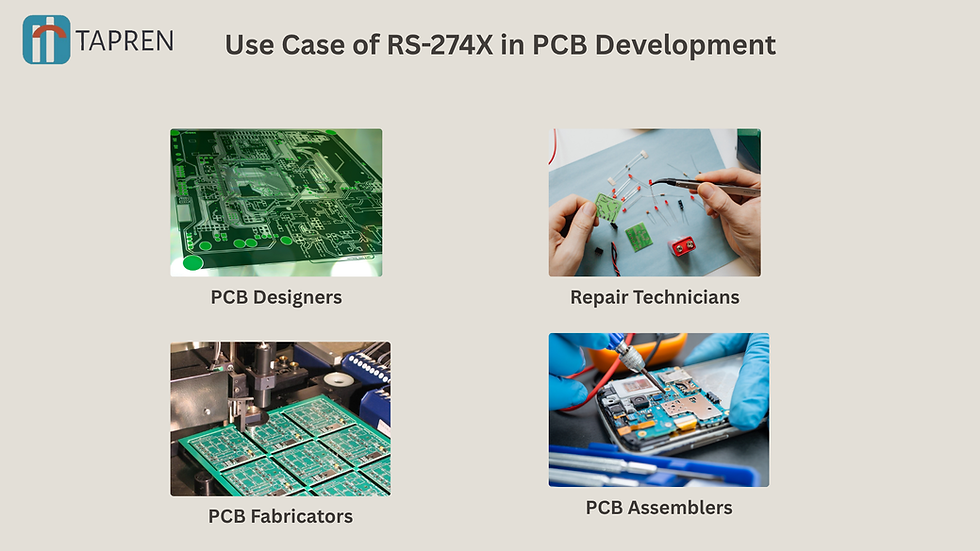
RS-274X plays a central role in the entire PCB design and manufacturing process:
PCB Designers
Export Gerber and drill information from CAD tools as fabrication deliverables. The design parameters will be accurately described as orders for fabrication.
Fabricators
Utilize Gerber data for CAM operations, such as photo plotting, drilling, routing, and imaging. RS-274X supplies the layer data and aperture specifications required by these CAM operations.
Assemblers
Utilize Gerber files to set up pick-and-place machines and Automated Optical Inspection (AOI) machines. This helps identify components and ensure accurate placement during assembly.
Repair Technicians
Utilize Gerber images for board examination and repair. The high-accuracy layer details enable technicians to understand the PCB layout and perform necessary maintenance.
Gerber vs. Drill Files

Limitations and Future Developments
While commonly employed, RS-274X does have some limitations. It is not inherent to embedded components and 3D models; therefore, if higher-level designs or 3D modeling are required, another format, such as IPC-2581 or STEP, might be more desirable. Future revisions of RS-274X will improve netlist integration and, possibly, 3D view generation. These enhancements aim to address current limitations while maintaining the simplicity and reliability of the format.
Conclusion
RS-274X remains an industry standard for PCBs due to its universal backing, simplicity, and reliability. Every CAD tool used in PCB design is capable of producing Gerber files, which are received by every fabrication house, allowing for seamless communication within the supply chain. The format's reliability and simplicity are also attested to by its plain file structure, which is easier to understand compared to complex ones like ODB++. Also, its text form makes it extremely portable and reliable. Despite the introduction of newer formats like IPC-2581 and ODB++, RS-274X remains in use, existing due to its simplicity and backward compatibility.
Tapren empowers engineers and manufacturers with Gerber-compatible workflows, precision tools, and expert support that simplify production and minimize errors.
Partner with Tapren to stay ahead in PCB innovation where performance, accuracy, and compatibility converge.
Key Takeaway
Emerging in 1998, RS-274X precedes RS-274 by accommodating diverse PCB layer specifications.
RS-274X offers universal compatibility with PCB CAD/CAM tools.
It provides layer flexibility for easy editing and manufacturing.
It provides precise aperture definitions and polarity control.
PCB, RS-274X, has a wide range of fabrication, assembly, and repair applications.
FAQs
What is the RS-274X format specification?
RS-274X is a standard ASCII text-based format for PCB manufacturing. It defines PCB design elements such as traces, pads, and apertures through a set of commands and coordinate data.
How do I convert Gerber files?
Gerber files can be converted using PCB design tools such as KiCad, Altium Designer, or online tools such as GerberView and EasyEDA. To convert between RS-274D and RS-274X, you may need a Gerber editor, such as GerbView, that authorizes you to open, edit, and save files in different formats. Online tools also offer conversion by uploading your Gerber files and selecting the desired output format.
How do I export RS-274X Gerber files in Altium?
To export RS-274X Gerber files in Altium, open your PCB project, go to Fabrication Outputs → Gerber Files, and choose RS-274X format. Select the necessary layers, configure the settings, and click Generate to export the files for manufacturing.
Why is RS-274X the industry standard for PCB fabrication?
RS-274X is widely used across the PCB industry. It consolidates all PCB design information into a single file, thereby reducing communication errors between designers and manufacturers. Its comprehensiveness also ensures an easier and more precise manufacturing process.


Comments