
Carbon Fiber PCB

Updated: Jul 22

Have you had challenges with traditional circuit boards that bend, overheat, or fail to perform at extreme temperatures? Many industries today are experiencing issues with standard FR-4 PCBs. The major problem with standard PCBs is that they lack the mechanical properties (rigidity) and thermal stability (heat resistance) needed for many emerging applications currently under exploration. Beyond their inherent limitations, traditional PCBs are typically unreliable in applications subjected to excessive stress (e.g., aerospace, automotive) or in high-frequency communications systems. Therefore, Carbon Fiber PCB presents a potential alternative to satisfy a critical industry requirement for a reliable, efficient, and long-lasting electronic device solution.
Carbon Fiber PCBs are a popular technology in leading-edge electronics due to their superior mechanical properties compared to traditional fiberglass PCBs. The main benefits are the light-weight nature of Carbon Fiber PCBs, improved mechanical (rigid) properties, and superior thermal management capabilities. All of which provides an attractive alternative to traditional PCB options. Therefore, it's becoming a very appealing technology for applications that require a reliable, efficient, and durable electronic device solution.
What is Carbon Fiber PCB?
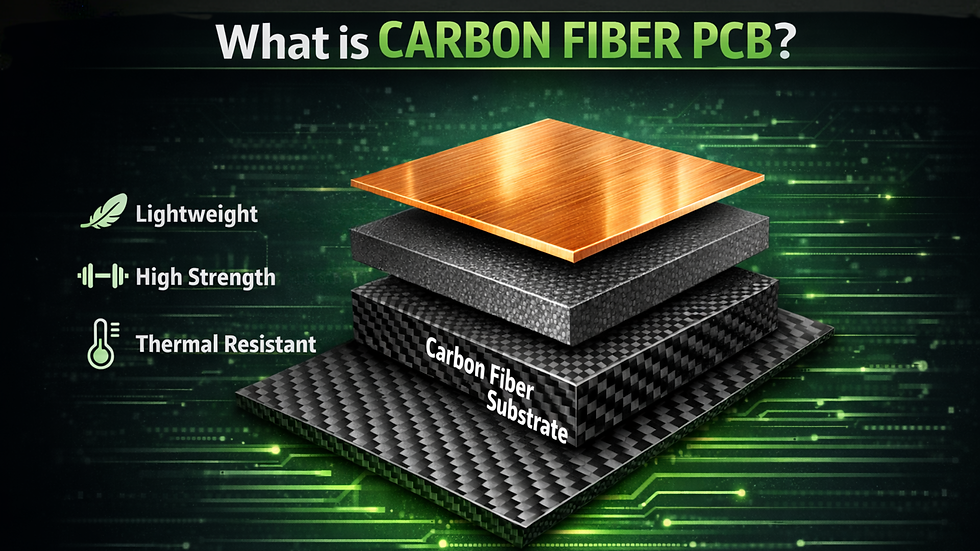
A Carbon Fiber PCB is an advanced electronic board that incorporates a Carbon Fiber composite into either the structural layer of the printed wiring board (PWB) or the substrate of the PWB. Instead of the typical FR-4 glass-reinforced epoxy used in a conventional PWB, manufacturers use carbon fiber to enhance the PWB's mechanical and thermal characteristics. When carbon fiber is combined with copper layers and a resin system during PWB manufacture, the resulting board will be very lightweight yet incredibly strong. Because of these unique properties, carbon fiber printed circuit boards are ideal for high-performance applications.
Key Properties of Carbon Fiber PCB

SUPERIOR MECHANICAL STRENGTH
Carbon fiber is among the most powerful materials used in contemporary design engineering. Due to their superior resistance to flexing, vibration, and various mechanical stresses, PCBs made with carbon fiber are excellent for aerospace, robotic, and automotive electronic designs.
LIGHTWEIGHT DESIGN
While carbon fiber's strength is unmatched, it also has the added benefit of being very light. A lighter structure is important in many areas, including drone development, satellite production, and the design of portable electronic equipment.
EXCELLENT THERMAL CONDUCTIVITY
Heat buildup is a significant problem when working on high-power electronic circuits. Carbon fiber PCBs will remove heat from the circuit more efficiently than other options, thus minimizing the potential for component failure and increasing overall system dependability.
CHEMICAL AND CORROSION RESISTANCE
Due to their chemical inertness, carbon fiber PCBs have been shown to resist moisture and corrosive substances. The use of carbon fiber PCBs enables electronic components to operate in harsh environments, including marine, industrial, and outdoor systems.
DIMENSIONAL STABILITY
Unlike other conventional materials that expand or contract with temperature changes, carbon fiber maintains dimensional stability even at extreme temperatures.
Manufacturing Process of Carbon Fiber PCB

Producing a Carbon Fiber PCB is more intricate and requires greater precision than producing a standard FR-4 PCB. This is due to the use of specialized materials, unique fabrication techniques, and rigorous quality control to achieve mechanical strength, thermal efficiency, and electrical reliability.
A carbon fiber PCB begins with careful material selection, followed by multi-layer lamination, patterning, and testing to complete the product.
Material Selection of Carbon Fiber PCB
The selection of materials for constructing a carbon fiber PCB will significantly impact its overall performance. A suitable combination of carbon fiber, resin, and copper will contribute to the desired mechanical and electrical characteristics of the final product.
Some key material considerations for selecting materials for a carbon fiber PCB include:
Type of Carbon Fiber Used
Typically, manufacturers use high-strength woven or unidirectional carbon fiber sheets. High-strength woven carbon fiber provides equal strength in all directions, whereas high-strength unidirectional carbon fiber provides the greatest strength in one axis. The type of carbon fiber used will depend on the application's specific needs.
Resin System
Carbon fiber is mixed with a matrix material, such as epoxy resin or a high-temperature thermoset resin, to create a stable composite substrate. In addition to providing good adhesion, the resin should also provide adequate thermal resistance and electrical insulation.
Copper Foil Choice
High-quality electrolytic or rolled copper foil is laminated to the carbon fiber substrate to produce a conductive path. In higher-power applications, thicker copper may be used to handle heavier current loads.
Insulation Between Dielectric Layers
Because carbon fiber is an electric conductor, it is necessary to add an insulated dielectric layer to prevent short-circuit conditions. Insulating films or special resin coatings can be added between the carbon fiber and copper layers.
After the above steps are completed, the manufacturing process begins.
A step-by-step explanation of how a carbon fiber PCB is made.

Step 1: Composite Substrate Formation: Sheets of carbon fibers are embedded in an epoxy resin, which is then cured under high-pressure, high-temperature conditions. The resulting composite is extremely strong and relatively light.
Step 2: Laminating Copper Foil: Thin sheets of copper foil are then attached to both sides of the carbon fiber substrate under extreme temperature and pressure, forming the first layer of the PCB.
Step 3: Circuit Patterning (Photolithography): An image of the circuit design is produced on a photo-sensitive coating that adheres to the copper surface of the PCB using ultraviolet (UV) light. The areas of the copper where UV light did not penetrate are chemically removed, thus producing the necessary electrical traces for the circuit.
Step 4: Drilling and Via Formation: Precision drilling equipment is used to drill holes into the PCB at locations where components will be mounted or where inter-layer connections will be made. Once drilled, the holes are electroplated with copper to provide the necessary electrical connections between layers of the PCB.
Step 5: Surface Finishing: Protective coatings are applied to the PCB to prevent copper oxidation and improve solderability.
Step 6: Laminating the multi-layers (if applicable): For PCBs made from multiple layers of carbon fiber, all layers are stacked and pressed together at extreme temperatures and pressure to produce a single, compact, high-density PCB.
Step 7: Electrical and mechanical testing: The finished PCB is tested for the following:
Electrical continuity
Thermal performance
Strength
Dimensional stability
Resistance to vibration and heat
The PCB does not enter production until it has passed all these tests.
Applications of Carbon Fiber PCB

The use of carbon fiber PCBs is crucial for the success of many modern electronic applications, including aircraft, satellites, and military electronic systems, where durability and lightweight materials are paramount. The carbon fiber board will reduce overall system weight while maintaining the same level of structural integrity as other PCB materials used today.
Automotive Electronics
With the advent of the electric vehicle (EV) and the autonomous vehicle, the need for advanced electronic PCBs has never been greater. These EV's and autonomous vehicles require high-performance PCBs that also provide superior thermal management and mechanical stability in what would otherwise be extremely harsh environments.
Telecommunications & 5G
Achieving the very high-frequency operation required in telecommunications and 5G systems requires an electronic substrate that is both highly stable and low-loss. This is exactly what carbon fiber PCBs provide in addition to superior thermal performance.
Medical Devices
Numerous medical devices use advanced imaging systems, wearable devices, and diagnostic equipment, all of which can benefit greatly from lightweight, reliable carbon fiber PCBs.
Consumer Electronics
Carbon fiber PCBs are being used by laptop and drone manufacturers, among others, to create thinner, higher-performance products.
Advantages of Carbon Fiber PCB Over Traditional PCBs
These six key areas show how carbon fiber PCBs may offer value-added solutions for manufacturing companies by delivering improved performance and/or lower cost of ownership in high-performance applications.

1. Higher durability and resistance to mechanical failure
Unlike FR-4 (fiberglass) printed circuit boards (PCBs), carbon fiber printed circuit boards (PCBs) exhibit greater resistance to deformation and fracture when subjected to mechanical stresses; therefore, they are ideal for applications in which the device is subject to vibrations, movements, or
physical impact, such as in autonomous vehicles, robotics, and aerospace.
2. Lower weight for advanced applications
Because of their use of lightweight carbon fiber, PCBs contribute less to the overall weight of electronic systems. Due to their lower weight, carbon fiber PCBs can be used in applications such as mobile devices and wearable technology.
3. Improved thermal management
Compared to typical PCBs, carbon fiber PCBs enhance thermal management. Carbon fiber PCBs enable heat generated by components to spread and dissipate away from sensitive components, thereby reducing the risk of overheating-related component failure and extending the life of an electronic system.
4. Greater thermal stability
FR-4 PCBs tend to warp and expand when exposed to extreme temperatures, while carbon fiber PCBs retain their shape and structural integrity under the same conditions. Manufacturers can now be assured that their PCBs will withstand the severe environmental conditions typically found in industrial and outdoor settings.
5. Resistant to moisture and chemical damage
Carbon fiber materials inherently possess properties that protect against corrosion, moisture, and various chemicals. The corrosion and chemical resistance of carbon fiber materials makes them suitable for marine electronics, medical devices, and industrial equipment designed to operate in a variety of hostile environments.
6. Long-term durability and low maintenance requirements
The strength, stability, and thermal performance of carbon fiber PCBs can result in a longer lifespan than that of FR-4 PCBs. With fewer replacements required, this can also translate into long-term cost savings.
Challenges of Carbon Fiber PCB

Although carbon fiber PCB offers many benefits, there are several limitations to consider for using this material on a PCB:
Carbon Fiber PCBs are Expensive: The cost of producing carbon fiber PCBs (both materials and process) is higher than that of traditional PCBs.
Fabricating a Carbon Fiber PCB is More Complicated: The process requires specialized equipment and/or skills to manufacture the board properly.
Using a Carbon Fiber PCB can Cause Conductivity Problems: Since carbon fiber has electrical conductivity, an adequate insulating layer is necessary to prevent short circuits or other issues that may arise from this property.
As technology advances, the cost of producing carbon fiber PCBs will decrease, making them easier to manufacture.
Future of Carbon Fiber PCB
Carbon fiber is now being used as an alternative substrate material for high-performance applications, including electric vehicles, aerospace, artificial intelligence, and renewable energy systems. It is anticipated that carbon fiber PCB will be key to future electronic design. Hybrid PCBs that incorporate carbon fiber, ceramic, and/or graphene are being researched by engineers to achieve even better performance.
Conclusion
Carbon Fiber PCBs represent tremendous innovation and technical advancements in the electronics manufacturing industry, offering exceptional mechanical properties, thermal efficiency, lightweight design, and long-term reliability as alternatives to standard PCB designs.
The use of carbon fiber PCBs has become a requirement for various industries that demand extremely durable, high-performance, and long-lived printed wiring boards (PWBs) or PCBs.
Investing in carbon fiber PCB technology will be a forward-thinking and intelligent decision if you want to remain innovative and competitive in product performance.
FAQs
1. Is it possible to use carbon fiber PCBs in high-frequency (RF) applications?
Yes, if you apply a proper insulating layer over the carbon fiber.
2. Are carbon fiber printed circuit boards recyclable?
Carbon fiber printed circuit boards are difficult to recycle; however, new technologies are emerging to allow the reuse of recycled carbon fibers.
3. Do carbon fiber printed circuit boards offer an alternative to using aluminum as heat sinks?
Yes, for most applications; however, high-power systems will often require additional cooling.


Comments